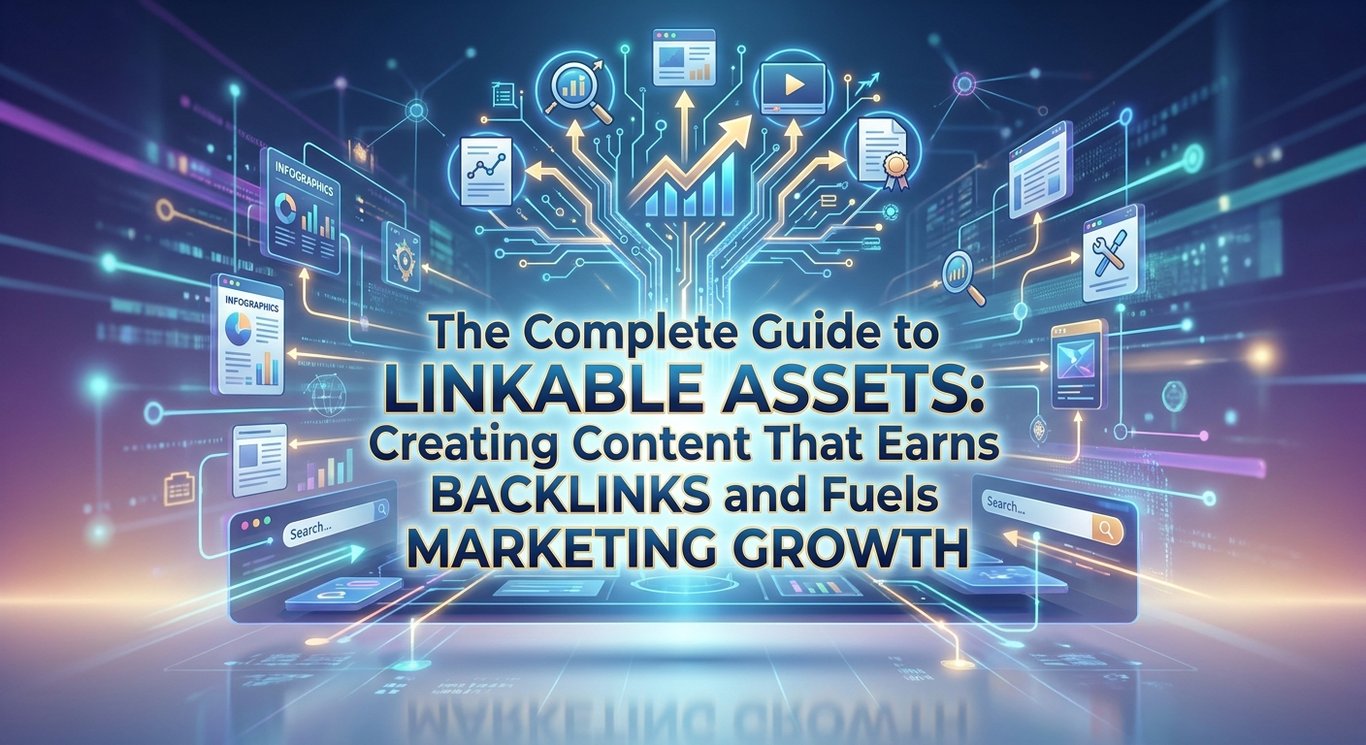
If you've ever published a blog post and watched it sit in silence — no shares, no links, no traffic — you already know the frustration of content that goes nowhere. Linkable assets are the antidote to that problem. In plain terms, a linkable asset is a piece of content so genuinely useful, original, or data-rich that other websites naturally want to reference it. Think of it as the kind of content people bookmark, share in Slack channels, and cite in their own articles. For SEO, digital PR, and overall marketing growth, these assets are game-changers — and this guide will show you exactly how to build them strategically instead of just hoping something sticks. 🎯
Here's the thing: backlinks are still one of the most powerful ranking signals in Google's algorithm, but earning them has become harder and smarter. Gone are the days when you could trade links or spin thin articles and see results. Today, the sites that consistently earn high-quality, organic backlinks are the ones publishing content that genuinely deserves to be referenced. Linkable assets sit at the heart of this shift — they build domain authority over time, attract links from credible publishers, and create a compounding SEO advantage that paid tactics simply can't replicate.
This guide is built for marketers, founders, SEO specialists, and content creators who are serious about building topical authority and sustainable organic growth. We'll walk through everything: how to research and choose the right topics, which asset formats earn the most links, how to create and promote them effectively, and how to measure results. Whether you're starting from scratch or looking to level up an existing content strategy, you'll leave with a clear, actionable roadmap. Let's get into it. 🚀
What Are Linkable Assets and Why Do They Matter for Modern SEO?
A linkable asset is a formally defined piece of high-value, authoritative content created with a specific purpose: to earn backlinks from other websites. This sets them apart from your average blog post or product page. A sales page is designed to convert. A news post is designed to inform in the moment. A linkable asset, on the other hand, is designed to be referenced — again and again — by journalists, bloggers, researchers, and industry publications. Think comprehensive guides, original data studies, free tools, or beautifully designed infographics. The intent behind the content is fundamentally different, and that intent shapes every decision from topic selection to formatting.
Google has made it increasingly clear that it rewards content that is genuinely helpful, original, and created for people — not search engines. Linkable assets are perfectly aligned with this philosophy. When a piece of content answers a real question in depth, provides unique data, or solves a specific problem better than anything else out there, publishers and bloggers naturally want to point their audiences toward it. That's the magic of earning links rather than building them artificially — the content does the heavy lifting because it actually deserves the attention.
Beyond earning individual backlinks, linkable assets play a structural role in your website's overall SEO health. Each high-quality external link pointing to an asset passes authority to your domain, which helps your entire site rank better for competitive keywords. And when you connect those assets to your most important landing pages through smart internal linking, you spread that authority strategically across your site. It's like building a network of authority hubs that lift everything around them — a much more durable strategy than chasing individual link placements.
What's often underappreciated is that linkable assets deliver marketing value far beyond SEO. A well-executed original research report, for example, can position your brand as a thought leader, generate press coverage, fuel social media content for months, and even drive direct leads. 💡 An interactive tool can become a go-to resource in your industry, keeping your brand top of mind with potential customers who might not be ready to buy yet. When you think about linkable assets as multi-purpose marketing investments rather than just SEO plays, the ROI case becomes much stronger.
Core Principles of High-Performing Linkable Assets
Not all content earns links — and the difference usually comes down to a handful of core attributes. The best linkable assets share these qualities: originality (they offer something genuinely new), credibility (they cite trustworthy sources or present first-party data), depth (they cover a topic thoroughly enough to be a definitive reference), usefulness (they solve a real problem or answer a real question), and ease of reference (they make it simple for other writers to pull out a quote, stat, or insight). Miss one of these, and you're creating content that's nice to have but easy to ignore.
Structure and design matter more than most content creators realize. A beautifully written guide buried in walls of text is still hard to cite. Editors and journalists who are writing on deadline need to scan your content quickly, find the key insight they need, and grab it confidently. That means using clear headings, concise summaries, pull-out statistics, and visuals that reinforce your main points. When your content is easy to navigate and visually credible, it dramatically increases the chances that a busy writer will reference it rather than move on to the next result.
Topical relevance and audience-first thinking are non-negotiable. A linkable asset needs to speak directly to the people who will actually link to it — usually other content creators, researchers, or industry professionals in your space. Generic content that tries to appeal to everyone ends up resonating with no one. And salesy or thin content? It almost never earns meaningful backlinks because it signals that the primary goal is promotion, not value. The more tightly your asset is focused on a specific audience's genuine needs, the more likely it is to become a go-to reference in that community.
One of the most powerful ways to make a linkable asset truly irreplaceable is to add something no one else can easily copy. This might be proprietary survey data, a unique analytical framework, a free tool built specifically for your audience, or a perspective drawn from years of direct industry experience. When your asset contains something that simply doesn't exist anywhere else, other sites have no choice but to link to you as the original source. That's the gold standard for linkable asset creation — and it's worth investing the extra effort to get there. ✨
Strategic Research: Finding Topics and Formats That Naturally Earn Links
Great linkable assets start with great research — and the first place to look is the search engine results page itself. For any target query in your niche, pull up the first page of Google and study what's already ranking. What formats are dominating — guides, tools, studies, list posts? What types of sites are linking to the top results? This SERP analysis tells you what the market has already validated as link-worthy content, and it gives you a benchmark to beat. If a 2,000-word guide is ranking and earning links, imagine what a deeper, better-designed, data-backed version could do.
Beyond manual SERP research, tools like Ahrefs, Semrush, Google Analytics, and Google Trends can surface powerful insights you'd never find by browsing alone. In Ahrefs or Semrush, you can look at your own top pages by referring domains to see which content is already earning links — then double down on those topics. You can also analyze competitor domains to find their most-linked pages and identify gaps you could fill with a superior asset. Google Trends helps you spot rising topics before they become saturated, giving you a first-mover advantage in your niche. 📊
"A linkable asset is any content, resource, or feature on your website that is inherently valuable and compelling enough to naturally attract backlinks from other websites." -Mailchimp
Some of the best asset ideas don't come from tools at all — they come from listening to real people. Spend time in communities where your target audience hangs out: Reddit threads, Quora questions, LinkedIn groups, niche Slack communities, and industry forums. Pay attention to questions that keep coming up, frustrations that never seem to get a satisfying answer, and debates that lack a definitive resource. Each of these is a signal that there's a content gap you could fill with a well-researched, in-depth asset that becomes the go-to reference for that question.
Competitor link profile analysis is one of the most underused research tactics in content strategy. Using a tool like Ahrefs' "Best by Links" report for a competitor's domain, you can see exactly which of their pages have earned the most backlinks — and often identify patterns in the formats, topics, and angles that consistently attract references. Maybe their industry salary report gets linked every year. Maybe their beginner's guide to a technical topic earns links from dozens of educational sites. These patterns are your roadmap for creating assets that will perform in your space.
After gathering all this research, the goal is to synthesize it into a focused shortlist of high-potential asset ideas. Look for topics that appear in multiple signals — high search volume, competitor link success, active community discussion, and a clear content gap. Then match each idea to the most suitable format based on what type of content naturally earns links in that context. A question about industry benchmarks calls for a data study. A "how do I do this" question calls for a step-by-step guide. Matching the format to the intent is what turns a good idea into a genuinely powerful asset.
Types of Linkable Assets That Work Best Today (with Examples)
There's no single type of content that earns all the links — different formats attract different kinds of references, and the best link-building strategies use a mix. Journalistic links tend to go to original data and research. Blogger links often point to comprehensive guides or useful tools. Resource page links favor curated lists and reference libraries. Understanding these distinctions helps you choose the right format for the type of links you're trying to earn and the audience you're trying to reach. 🎨
Long-form guides, tutorials, and "how-to" resources are the bread and butter of linkable asset creation. When done well, these pieces go deep on a topic — covering it more thoroughly than anything else in the search results — and they stay relevant for years. A well-structured beginner's guide to a technical topic, for example, becomes a natural reference point for anyone writing introductory content in that space. The keys to making these work are genuine depth, clear structure, and evergreen value that doesn't expire after six months.
Original research, surveys, and statistics pages are arguably the most powerful link magnets available to content creators today. When you publish data that doesn't exist anywhere else — whether it's a survey of 500 industry professionals, an analysis of millions of data points, or a compilation of the latest statistics on a trending topic — journalists and industry writers have no choice but to cite you as the source. The methodology matters too: being transparent about how you collected your data builds credibility and makes your findings more citation-worthy in academic and professional contexts.
Tools, calculators, templates, and interactive assets occupy a unique category because they earn links through utility rather than information alone. A free ROI calculator, a keyword difficulty estimator, a budget planning template, or an interactive quiz can become embedded resources across dozens of websites — each embedding or mention generating a backlink. These assets also tend to have incredible stickiness: users bookmark them, return to them, and share them with colleagues, creating a compounding visibility effect that static content rarely achieves. 🛠️
"Building linkable assets requires a thoughtful and strategic process encompassing research, content creation, and effective promotion." -Mailchimp
Visual assets like infographics, charts, data visualizations, and diagrams earn links in a very specific way: when someone embeds your image or uses your visual in their own content, they typically credit the source with a link. A well-designed infographic summarizing complex data, or a clear diagram explaining a process, can circulate across blogs, news sites, and social platforms for years. The key is making visuals embeddable and clearly branded so the source is obvious — and making the data compelling enough that people actually want to share it.
Beyond these core formats, there are several other asset types worth mentioning. Case studies with real numbers and transparent results attract links from practitioners who want to cite real-world evidence. Curated list posts — like "50 best tools for X" or "the ultimate resource list for Y" — earn links from the sites featured and from readers who bookmark them as reference guides. Resource libraries and transparent pricing or affiliate pages can also attract niche links when they're genuinely useful and well-maintained. The best format always depends on your audience and goals, but having a diverse portfolio of asset types gives you multiple link-earning angles simultaneously.
Planning and Structuring Linkable Assets Around Search Intent
Before you write a single word, you need to be crystal clear about the search intent your asset is serving. Is someone searching for information to learn something? Are they comparing options before making a decision? Are they looking for a specific tool or resource to use right now? Each of these intents calls for a different type of content and a different structure. Mapping your asset to the right intent ensures it answers what searchers — and potential linkers — actually want, which is the foundation of both ranking success and link acquisition.
Individual linkable assets are most powerful when they're part of a larger topic cluster strategy. A pillar page covers a broad topic at a high level and links to more detailed supporting content on specific subtopics. When your linkable assets are built into this cluster structure, they don't just earn links for themselves — they strengthen your site's overall topical authority on that subject. This signals to Google that your site is a comprehensive, trustworthy resource on the topic, which lifts rankings across the entire cluster rather than just for individual pages.
Structure your headings, subtopics, FAQs, and how-to steps around the actual language people use when searching. Look at the "People Also Ask" boxes, related searches, and autocomplete suggestions for your target queries — these are direct signals from Google about what users want to know. When your asset answers these questions clearly and completely, it becomes more likely to rank for a wide range of related queries and more likely to be discovered by writers looking for a credible source to reference in their own content.
Internal linking is one of the most underutilized strategies in content marketing, and it's especially important when you're building linkable assets. Every time a linkable asset earns an external backlink, that authority flows into your domain — but you can direct where it goes next through smart internal links. By connecting your linkable assets to your most important commercial pages, category pages, or other strategic content, you spread that hard-earned authority throughout your site and amplify the SEO impact of every external link you earn. Think of it as a distribution network for authority. 🔗
Before diving into creation, invest time in building a detailed content brief for each asset. Define the primary keyword and supporting queries, outline the key sections and what each needs to cover, identify the data or unique insights you'll include, and clarify the specific job this asset does for its reader. This "job-to-be-done" thinking keeps the asset tightly focused and prevents the common trap of creating something that's long but not actually useful. A focused, purposeful asset almost always outperforms a sprawling one that tries to cover everything without depth.
"Linkable assets should be the cornerstone of your SEO strategy. They attract valuable backlinks, which in turn help you rank higher." -Respona

Creating Linkable Assets: From Idea to Publish-Ready Content
Creating a great linkable asset follows a clear process, and skipping steps is how you end up with content that underperforms. Start by validating your idea — confirm there's genuine search demand, that competitors haven't already created something definitively better, and that you have access to the data or expertise needed to do the topic justice. Then move into research and data gathering, followed by drafting, designing, and a thorough quality review before launch. Each stage builds on the last, and rushing any of them tends to show up in the final product.
When collecting data and statistics for your asset, prioritize reputable, primary sources — government databases, peer-reviewed research, industry association reports, and your own original surveys. Annotate each statistic clearly with its source and date so readers can verify it. Then go a step further by adding your own analysis: what does this data mean for your audience? What's surprising about it? What action should someone take based on these numbers? This original layer of analysis is what separates a genuinely valuable asset from a lazy data dump that anyone could have assembled.
Writing technique matters enormously for linkable assets. Your introduction needs to immediately establish why this piece is worth reading — what problem it solves, what unique insight it offers, or what the reader will be able to do after reading it. The body should flow logically from one section to the next, with each section building on the last. Side-by-side comparisons, real-world examples, and practical "how to apply this" sections make abstract information concrete and actionable. The more a reader feels like they're getting genuine expertise — not just information — the more likely they are to share and cite your work.
Design is not an afterthought for linkable assets — it's a core part of what makes them citation-worthy. Use visual hierarchy to guide readers through the content: clear H2s and H3s, bold key takeaways, callout boxes for important stats, and charts or graphics that make data easier to grasp at a glance. If you include downloadable elements like templates, checklists, or PDF versions, make sure they're branded and easy to share. Every design decision should serve the goal of making your content easier to read, easier to reference, and more credible at first glance. 🎨
Quality assurance for linkable assets goes beyond proofreading. Fact-check every claim, verify every statistic, and make sure every source you cite is credible and current. Google's E-E-A-T framework — which stands for Experience, Expertise, Authoritativeness, and Trustworthiness — is increasingly central to how content is evaluated, so demonstrate real expertise through depth of analysis, cite authoritative sources, and make it clear who created the content and why they're qualified. Also plan for regular updates: an asset that was accurate in 2023 may need refreshing in 2025 to maintain its credibility and continued link-earning potential.
Before hitting publish, run your asset through one final test: ask someone outside your team to read it and answer honestly — "Would you cite this in your own writing?" If the answer is hesitant, dig into why. Maybe the data needs to be more prominent. Maybe a section feels thin. Maybe the design doesn't match the quality of the writing. Keep refining until the answer is a confident yes. This simple gut-check question cuts through all the internal bias and gets to the heart of what makes a linkable asset actually link-worthy. ✅
Promoting Linkable Assets for Maximum Backlink Acquisition
Here's a hard truth that a lot of content creators learn the painful way: even the best linkable asset in the world won't earn links if no one knows it exists. Promotion is not optional — it's half the job. The "publish and pray" approach might occasionally work for viral content, but for strategic link building, you need deliberate outreach and promotion to get your asset in front of the people most likely to reference it. Think of creation and promotion as equally important phases, not one being more important than the other.
"Effective linkable content includes research, tools, infographics, and detailed resources tailored to different audience needs." -Bazoom
Personalized outreach to relevant websites, bloggers, and journalists is one of the most effective ways to earn initial backlinks for a new asset. The key word here is personalized — generic "hey, check out my article" emails get ignored. Instead, reference specific content the recipient has published, explain why your asset is genuinely relevant to their audience, and make it easy for them to see the value without having to dig for it. A short, specific, respectful pitch that respects the recipient's time almost always outperforms a long, self-promotional email blast. 📧
Digital PR is a powerful channel for linkable assets, especially those containing original data or research. Platforms like HARO (Help a Reporter Out) and Qwoted connect you with journalists actively looking for expert sources and data — and if your asset provides what they need, you can earn high-authority links from major publications. You can also proactively pitch industry publications by offering exclusive access to your data, custom charts, or expert commentary. The more you position your asset as a resource for journalists rather than a promotion for your brand, the better your results will be.
Multi-channel promotion amplifies the reach of your linkable asset far beyond direct outreach. Share it in your email newsletter with a compelling hook. Post key statistics and insights as native content on LinkedIn, Twitter/X, and relevant social platforms. Repurpose the asset into derivative formats — a short video summarizing the key findings, a podcast episode discussing the research, or a series of social posts breaking down each major section. Each piece of derivative content creates new entry points for people to discover the original asset and potentially link to it. 📱
Social listening and community engagement are often overlooked promotion channels, but they can be remarkably effective. Set up alerts for keywords related to your asset's topic, and when someone asks a relevant question in a Reddit thread, LinkedIn group, or industry forum, share your asset as a genuinely helpful resource (not as spam — context and helpfulness matter). Share key stats as native posts that invite discussion, and tag or notify relevant influencers who might find the content interesting. These organic touchpoints often lead to shares and links from people who discover your asset through community engagement rather than direct outreach.
Finally, don't overlook unlinked brand mentions as a link-building opportunity. Use tools like Ahrefs, Google Alerts, or Brand24 to monitor the web for mentions of your brand, your asset's title, or key statistics from your research. When you find a mention that doesn't include a link, reach out politely and ask the author to add one. Most writers are happy to do so — they've already acknowledged your work, so adding a link is a small additional step. Over time, converting unlinked mentions into backlinks can add up to a meaningful number of high-quality links with relatively little effort.
Measuring Success: How to Track Links, Authority, and Business Impact
You can't improve what you don't measure, and linkable assets are no exception. The core SEO metrics to track for each asset include the number of referring domains (unique websites linking to it), the quality and authority of those linking domains, the diversity of anchor text used in those links, and the organic traffic the asset generates over time. These metrics together give you a picture of both the quantity and quality of the links your asset is earning — and they're the foundation of any honest assessment of your link-building performance. 📈
SEO tools like Ahrefs, Semrush, and Moz make it relatively straightforward to track backlinks at the page and domain level. Set up regular monitoring for your key linkable assets so you can see when new links are earned, identify which assets are performing best, and spot any link losses that need attention. Over time, you'll start to see clear patterns — certain topics, formats, or angles that consistently outperform others — and these patterns should directly inform your future asset creation priorities.
"Promotion matters just as much as creation. Once your asset is live, promote it through targeted outreach to blogs or newsletters in your niche, internal linking from high-traffic pages, and repurposing into quotes, graphics, or data snippets for broader use." -Breaking B2B
Beyond individual link counts, pay attention to broader authority signals. Is your domain rating or domain authority improving over time? Are you ranking higher for the competitive keywords you care about? Are you seeing more branded search volume — people specifically searching for your company or your asset by name? These are signs that your linkable asset strategy is working at a domain level, not just driving isolated wins. Authority building is a long game, and these aggregate signals tell you whether you're moving in the right direction.
Linkable assets should also be measured against business and marketing metrics, not just SEO metrics. Track how many leads, signups, or demo requests can be attributed to traffic from your linkable assets. Monitor social shares, newsletter growth driven by asset promotion, and any press coverage generated by your research or data. These metrics make the business case for continued investment in linkable asset creation — especially when talking to stakeholders who care more about revenue than domain authority. 💼
Build a simple reporting framework that you review on a regular cadence — monthly or quarterly works well for most teams. For each major asset, track referring domains, organic traffic, keyword rankings, and business conversions. Compare performance across your asset portfolio to identify which types and topics are delivering the strongest ROI. Use these insights to make smart decisions about which assets to refresh with updated data, which formats to scale, and which topics to prioritize in your next content roadmap cycle.

Scaling Linkable Assets and Integrating Them into Your Marketing Strategy
Starting with one or two strong linkable assets is the right move — but the real power comes from building a portfolio over time. As you publish more assets across key topics in your niche, your brand starts to be recognized as an authoritative source by both search engines and human readers. Each new asset reinforces the authority of the others, and your domain becomes increasingly difficult for competitors to displace in search results. Think of it less like publishing individual pieces and more like constructing a library of reference-worthy resources that collectively define your brand's expertise. 📚
A content roadmap is essential for scaling linkable assets strategically rather than randomly. Map out your planned assets for the next six to twelve months, prioritizing topics that align with both your marketing goals and the highest-potential link opportunities identified in your research. Consider how each asset supports a product launch, a seasonal campaign, or a long-term positioning goal. When your content calendar is driven by strategic intent rather than "what should we write about this week," every asset you create has a clear purpose and a higher chance of delivering meaningful results.
Successful linkable assets shouldn't be treated as one-and-done publications — they should be refreshed and repurposed to extend their value over time. Update statistics annually to keep them accurate and citation-worthy. Repurpose a popular guide into an infographic, a video series, or an interactive tool. Turn a data study into a webinar or a conference presentation. Each repurposed format creates new opportunities for links and exposure, and it extends the useful life of the original research investment. The best assets can earn links for years if they're maintained and actively promoted. 🔄
Linkable asset creation works best when it's a collaborative effort across teams. SEO brings keyword research and link opportunity analysis. Content brings writing quality and editorial judgment. PR brings media relationships and outreach expertise. Product brings unique insights and data that only insiders can access. When these teams work together toward shared goals — rather than in silos — the resulting assets are richer, better promoted, and more strategically aligned with what the business actually needs. Regular cross-functional meetings to align on upcoming asset plans can make a significant difference in output quality.
Finally, be realistic about the resources required to do linkable asset creation well. High-quality research, writing, design, and promotion all take time and money — and cutting corners on any of them tends to produce content that doesn't earn links. Build a sustainable budget that covers not just creation but also ongoing promotion, tool subscriptions for tracking, and periodic updates. When you treat linkable assets as long-term investments rather than one-time expenses, the math starts to look very favorable: a single strong asset can earn dozens of high-quality links over its lifetime, delivering compounding SEO value that far outweighs its creation cost.
Frequently Asked Questions About Linkable Assets
What is a linkable asset in SEO?
A linkable asset in SEO is any high-value piece of content — a comprehensive guide, original research study, free tool, infographic, video, or curated resource list — that is created specifically to attract backlinks and citations from other websites. The defining characteristic is that it's built to be referenced, not just read. It offers something genuinely useful, original, or data-rich that makes other writers and publishers want to point their audiences toward it as a credible source.
It's important to understand that the primary goal of a linkable asset is to earn references and build authority — not to directly sell a product or service. That said, linkable assets absolutely can and do drive indirect business value. When people discover your brand through a resource they find genuinely useful, trust is built long before any sales conversation happens. That trust translates into leads, conversions, and long-term customer relationships that are far more valuable than a single transaction.
Which types of linkable assets earn the most backlinks?
The formats that consistently earn the most backlinks include original research and statistics pages, in-depth how-to guides and tutorials, free tools and calculators, and curated resource lists. Original data is particularly powerful because journalists and industry writers need to cite a source when they reference statistics — and if your research is the only place that data exists, you become the mandatory citation. Tools earn links through utility and embeddability, while comprehensive guides earn links by becoming the definitive reference on a topic.
That said, the "best" asset type is always relative to your specific audience and niche. In some industries, a beautifully designed infographic summarizing complex data will outperform a long-form guide. In others, a free calculator or template will earn far more links than any written content. Data-rich or tool-based assets often outperform standard blog posts across most niches, but the most reliable approach is to study what's already earning links in your specific space and let that guide your format decisions.
How many linkable assets do I need to see results?
Most experts recommend starting with one or two "killer" assets — pieces that are so comprehensive, data-rich, or uniquely useful that they can serve as central hubs of authority in your niche. These flagship assets become the foundation of your link-building strategy, and everything else you create can support and reinforce them. Trying to create ten mediocre assets instead of two excellent ones is a common mistake that leads to diluted effort and disappointing results.
Quality and promotion matter far more than quantity. A single well-executed linkable asset, promoted strategically to the right audiences, can earn dozens or even hundreds of backlinks over its lifetime — delivering more SEO value than a hundred forgettable blog posts. Once you've proven the model with a strong initial asset and learned what works in your niche, you can gradually expand your portfolio with confidence that each new addition will perform. 💪
Can small websites compete with bigger brands using linkable assets?
Absolutely — and in many ways, smaller sites have advantages that larger brands struggle to replicate. Big companies often move slowly, focus on broad topics, and produce content by committee that ends up being safe but unremarkable. A small, focused brand can move quickly, go deep on niche topics, and publish original data or highly practical content that larger competitors simply overlook. Niche specificity is a superpower in linkable asset creation, and it's one that smaller sites can leverage very effectively.
Building a focused portfolio of linkable assets around a tightly defined topic area is one of the most effective ways for small brands to punch above their weight in organic search. By establishing topical authority through a cluster of high-quality assets, a small site can outrank and out-link much larger competitors for the specific queries that matter most to its audience. It takes patience and consistency, but the compounding effect of topical authority is very real — and very achievable for brands of any size. 🏆
How long does it take for a linkable asset to start earning backlinks?
The timeline varies quite a bit depending on how you promote the asset and how competitive your niche is. Some assets earn links within days of publication — especially if you have an active outreach campaign running alongside the launch, or if the asset contains timely data that journalists are actively looking for. Digital PR placements can happen very quickly when the right asset lands in front of the right reporter at the right time. In these cases, you might see a meaningful number of backlinks within the first week or two.
For most assets, however, the link-earning process is more gradual. As the content begins to rank in search results, it gets discovered organically by writers and researchers who then reference it in their own work. This organic discovery phase can take weeks or months to build momentum, but it tends to produce the most sustainable and high-quality links over time. Consistent promotion, ongoing relationship building with relevant publishers, and periodic updates to keep the asset fresh can significantly extend its link-earning window — sometimes for years after the original publication date. ⏳
Conclusion: Turning Linkable Assets into Long-Term Marketing Growth
The core takeaway from this complete guide to linkable assets is straightforward: linkable assets are strategic, high-value content pieces designed to earn backlinks, build domain authority, and drive broader marketing impact — and they work when they're grounded in genuine audience research, the right format choices, and deliberate promotion. There are no shortcuts here. Success depends on originality, clarity, ongoing optimization, and a commitment to creating content that genuinely deserves to be referenced. Quick, one-off tactics might generate a spike, but a portfolio of well-executed linkable assets builds the kind of compounding authority that sustains organic growth for years.
Now it's time to put this guide into action. Start by picking one high-potential topic in your niche — something your audience genuinely needs a better resource for. Choose a format that matches the type of links you want to earn and the kind of content that performs in your space. Commit to a full cycle of creation, outreach, and measurement before moving on to the next asset. Research your SERPs and audience needs thoroughly, design something genuinely useful and well-structured, promote it across every relevant channel, and track your results carefully so you know what to scale. That's the engine — and once it's running, it only gets more powerful over time. 🔥