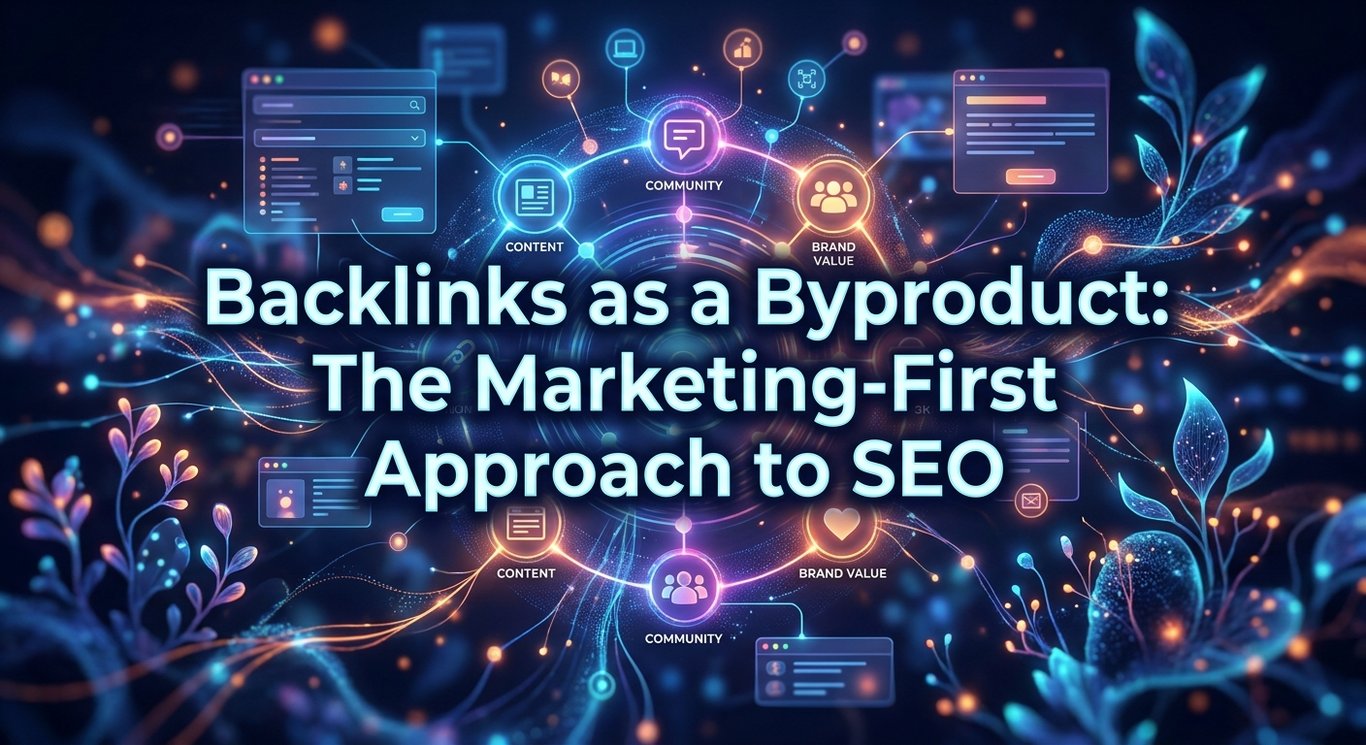
There's a quiet revolution happening in the world of SEO, and it's changing how smart marketers think about backlinks. For years, the prevailing wisdom was simple: more links equal better rankings. So teams spent countless hours on cold outreach, guest post swaps, and directory submissions — all in pursuit of that next link. But here's the thing: the brands winning in search today aren't necessarily the ones with the most aggressive link-building campaigns. They're the ones doing great marketing. 🚀 Backlinks, in this modern model, aren't the goal — they're a natural side effect of building something people genuinely value and talk about.
Search engines like Google have grown remarkably sophisticated at understanding which links are earned and which are manufactured. When a brand creates real authority, publishes genuinely useful content, and builds trust with its audience, other websites naturally want to reference it. That's the core idea behind the marketing-first approach to SEO: instead of asking "how do we get more links?" you ask "how do we become the most trusted, helpful, and visible brand in our space?" The links follow because the marketing is working — not the other way around.
This article is written for SEOs who are tired of chasing links that don't move the needle, content marketers who want their work to compound over time, and founders who want sustainable organic growth without playing games that could get their site penalized. By the end, you'll understand why the shift from traditional link building to a marketing-led strategy is one of the most important moves you can make — and exactly how to execute it. Let's dig in. 🎯
What Are Backlinks and Why Search Engines Care
A backlink is simply a link from one website to another. When a blog post, news article, or resource page links to your site, that's a backlink pointing your way. Search engines treat these links like votes of confidence — a signal that other websites find your content valuable enough to reference. But it's not just about the raw number of votes. Search engines also look at the authority of the site doing the linking, the relevance of the content surrounding the link, and whether the link is likely to send real, interested traffic to your page. All of these factors combine to tell Google something meaningful about how trustworthy and useful your site is.
Quality, context, and intent matter far more than sheer volume when it comes to backlinks. A single link from a respected industry publication can carry more weight than a hundred links from obscure, low-traffic blogs. Why? Because that publication has already earned the trust of its readers and of search engines. When it vouches for your content, that endorsement carries real credibility. Similarly, a link that's placed naturally within a relevant article — where it genuinely helps the reader — signals intent that's completely different from a link stuffed into a spammy sidebar or buried in a footer. Context is everything.
The role of backlinks in SEO has evolved significantly over the past two decades. In the early days of search, links were almost the only signal that mattered, and the web was flooded with link manipulation as a result. Today, backlinks remain one of the most important ranking factors, but they work alongside content quality, technical performance, and user experience signals. Think of them as one pillar in a larger structure — powerful when combined with everything else, but not capable of holding up a weak site on their own. Understanding this broader picture is the first step toward a smarter, more sustainable SEO strategy.
Backlinks vs. Other Core SEO Signals
Backlinks don't exist in a vacuum — they work alongside keyword research, on-page optimization, site speed, mobile usability, and structured data to determine how well a page ranks. If your technical SEO is broken or your content doesn't match what users are actually searching for, even a flood of high-quality backlinks won't save you. Each pillar of SEO supports the others. Strong on-page optimization makes your content easier for search engines to understand, which in turn makes it easier for the right links to amplify your rankings. Neglect any one pillar and you're leaving performance on the table.
The most important thing to understand is that backlinks amplify value that already exists — they don't create it. If your content is thin, your site is slow, or your user experience is frustrating, backlinks will do very little for you. But when you've built something genuinely useful and well-optimized, a strong link profile can dramatically accelerate your visibility. This is why the marketing-first approach is so powerful: it focuses on building real value first, knowing that backlinks will follow and then multiply the impact of that value. Links are the accelerant, not the fuel. 🔥
From Link Building to Marketing-First SEO: Why the Shift Matters
Traditional link building has a long and complicated history. The tactics are familiar to most SEOs: reach out to hundreds of websites asking for guest post opportunities, submit your site to directories, swap links with partners, or pay for placements on relevant blogs. Some of these approaches still have a place in a well-rounded strategy, but they come with serious limitations. They're time-consuming, often expensive, and when done in isolation — without strong content or a real brand behind them — they tend to produce links that don't actually move rankings or drive meaningful traffic. Worse, they can feel like a hamster wheel that never really ends.
Google's increasing focus on user experience and its E-E-A-T framework — which stands for Experience, Expertise, Authoritativeness, and Trustworthiness — has made purely manipulative link building less sustainable than ever. Algorithm updates have repeatedly targeted low-quality, artificially acquired links, devaluing them or actively penalizing sites that rely on them. Google isn't just looking at whether you have links — it's looking at whether those links make sense given who you are, what you publish, and how real people interact with your brand. Trying to game this system with manufactured links is increasingly a losing bet. 😬
The marketing-first approach flips the script entirely. Instead of treating link building as a separate SEO activity, it treats great marketing as the source of all link acquisition. When you run a compelling PR campaign, publish original research, launch a useful tool, or become a recognized voice in your industry through speaking and media appearances, links come naturally. They come because journalists need to cite your data, because bloggers want to share your tool, and because other brands want to associate with your credibility. This approach doesn't just earn links — it builds a brand that keeps earning them over time.
How Backlink Value Has Changed Over Time
In the early days of SEO, getting links was almost embarrassingly simple. Quantity ruled, and it didn't matter much where those links came from. This led to an explosion of link schemes: link farms, paid networks, automated directory submissions, and reciprocal link exchanges that had nothing to do with real value or relevance. For a while, these tactics worked. But as search engines matured, they got much better at distinguishing between links that were earned and links that were bought or manufactured. Major algorithm updates — like Google's Penguin — sent shockwaves through the SEO industry and wiped out rankings for sites that had relied on manipulative tactics.
Today, the links that hold up best through algorithm updates are the ones earned through genuine marketing and PR activity. A link from a major news outlet that covered your original research, or from a popular podcast that featured your founder, or from a partner's website because you collaborated on a project — these links are deeply authentic. They reflect real relationships and real value. They're also far more likely to send actual traffic and build brand recognition, which compounds their SEO benefit. The shift from quantity to quality isn't just a Google preference — it's a reflection of how trust actually works on the internet. 🌐
"Backlinks offer better website SEO because they boost your website’s authority and can help you rank higher for target keywords in search engine results pages (SERPs)." -Mailchimp
E-E-A-T and Topic Authority: The Foundation of Marketing-First SEO
E-E-A-T — Experience, Expertise, Authoritativeness, and Trustworthiness — is Google's framework for evaluating whether content deserves to rank well and be trusted by users. It's not just about having credentials listed on a page. It's about demonstrating, through consistent publishing and real-world expertise, that your brand genuinely knows what it's talking about. When a site consistently publishes content that solves real problems, written by people with actual experience in the topic, search engines take notice. And so do other websites, journalists, and creators who are looking for credible sources to reference in their own work.
Owning a topic — rather than just targeting individual keywords — is one of the most powerful things you can do in modern SEO. When you build deep, interconnected content around a specific subject, you signal to search engines and to your audience that you are the go-to resource on that topic. This naturally attracts mentions and citations from others who write about related subjects. If you're the brand that has published the most comprehensive, most useful, most frequently updated content on a given topic, people will link to you because you're the obvious reference — not because you asked them to. That's the marketing-first mindset in action.
Connecting this back to marketing: becoming the go-to brand in a niche requires consistent publishing, genuine helpfulness, and a willingness to invest in content that serves your audience rather than just your rankings. Brands that do this well — think of the companies whose blog posts you've bookmarked, whose newsletters you actually read, whose tools you use every day — attract links almost effortlessly. Their marketing creates authority, and their authority creates links. It's a virtuous cycle that's incredibly hard to replicate through outreach alone. 💡
Why Authority Attracts Links Without Outreach
When your brand becomes a recognized authority in a topic area, something remarkable happens: other people start doing your link building for you. Journalists writing about your industry cite your data. Bloggers reference your guides as the definitive resource. Educators link to your tools because they're the best available. This happens because authoritative resources — original research, industry benchmarks, comprehensive tutorials — naturally become the reference points that other creators rely on. You stop chasing links and start being cited, which is a fundamentally different and far more scalable position to be in.
The shift from "chasing" to "being cited" is the clearest sign that a marketing-first approach is working. It means your content has achieved the kind of usefulness and credibility that makes it a natural part of other people's work. This doesn't happen overnight, but it compounds beautifully. Every piece of authoritative content you publish increases the chances that someone, somewhere, will link to it without you ever having to ask. Backlinks truly become a byproduct — a signal that your marketing is resonating, your brand is trusted, and your content is genuinely valuable. 🏆
Designing Linkable Assets Through Real Marketing
A "linkable asset" is any piece of content or resource that is so useful, interesting, or unique that other websites naturally want to reference it. Think free tools, original research reports, interactive calculators, detailed industry guides, data visualizations, and comprehensive tutorials. These assets work exceptionally well in a marketing-first SEO strategy because they serve multiple purposes simultaneously. They attract links, yes — but they also generate leads, build brand awareness, educate potential customers, and demonstrate expertise. The link acquisition is almost a bonus on top of all the other marketing value they create.
The key to designing effective linkable assets is identifying gaps in your market — places where there isn't already a great resource that serves your audience's needs. What questions are people in your industry constantly asking that nobody has answered well? What data does your audience wish existed? What tool would make their job easier? When you create something that fills a genuine gap, you're not just building an SEO asset — you're doing real marketing. You're solving a problem, and people naturally share and link to solutions that make their lives easier. That's the marketing-first mindset applied to asset creation. 🛠️
"In local SEO, quality backlinks often come from how well your business serves customers, vendors, and partners." -Kingdon Marketing
Importantly, linkable assets should serve your marketing goals first. A calculator that helps potential customers understand their ROI from your product serves both as a lead generation tool and as something industry bloggers will link to. A research report that reveals surprising trends in your industry builds brand credibility and earns media coverage. An in-depth tutorial that genuinely teaches a skill builds trust with your audience while becoming a go-to reference for other educators. When you design assets this way — marketing value first, links as a secondary outcome — you end up with resources that perform better on every dimension.
Examples of High-Performing Linkable Assets
Some of the most consistently linked-to assets across industries include free tools and calculators, original data studies, comprehensive checklists, local guides, industry-specific templates, and interactive content like quizzes or assessments. A mortgage calculator gets linked to by personal finance bloggers. A free SEO audit tool gets mentioned in marketing roundups. A salary survey gets cited by journalists writing about labor trends. What these assets have in common is utility — they make someone else's job easier, or they provide information that's genuinely hard to find elsewhere. That utility is what drives both links and conversions. 📊
Beyond just earning links, these assets drive real business outcomes. A well-designed template can capture email addresses. A research report can generate media coverage that introduces your brand to thousands of new potential customers. An interactive tool can demonstrate your product's value in a way that a sales page never could. This is the beauty of thinking about linkable assets through a marketing lens: you're not just optimizing for link acquisition, you're building resources that grow your audience, build trust, and move people through your funnel — with backlinks as a very welcome side effect.
Marketing Channels That Naturally Generate Backlinks
Many of the most effective backlink-generating activities aren't SEO tactics at all — they're just good marketing. PR campaigns that land your brand in major publications almost always include a link back to your site. Podcast appearances introduce you to new audiences and frequently result in a link from the podcast's show notes page. Webinars and virtual events often earn links from partner organizations and attendees who blog about what they learned. Community sponsorships and local partnerships frequently result in mentions on organization websites. Each of these channels is doing double duty: building your brand and earning links at the same time. 🎙️
Platform launches are another underrated source of backlinks. When you launch a product or tool on platforms like Product Hunt, you often earn links from the platform itself, from bloggers who cover new launches, and from early users who write reviews or tutorials. The same is true for launching in relevant online communities, submitting to software directories, or being featured in industry newsletters. Each of these activities introduces your brand to a new audience segment and often comes with a citation that passes both link equity and referral traffic. The key is that you're showing up somewhere your audience already spends time.
When marketing is planned with digital visibility in mind, everything compounds. A PR campaign that earns a feature in a major publication boosts branded searches, which signals to Google that people are actively looking for your brand. That same feature might drive traffic to a linkable asset on your site, which earns additional links from people who discover it through the article. Podcast appearances drive listeners to search for your brand, which again increases branded search volume. Links, brand recognition, and referral traffic all grow together when you approach marketing holistically. It's not about any single channel — it's about building a presence that makes links inevitable. 🌟
Leveraging Existing Relationships for Earned Links
One of the most overlooked sources of high-quality backlinks is the network of relationships your business already has. Suppliers often have "trusted partners" pages on their websites. Customers who love your product might be willing to feature you in a case study on their blog. Local organizations you support through sponsorships often list their sponsors on their websites. Co-marketing campaigns with complementary brands create natural opportunities for mutual mentions. These relationship-based links are often easier to earn than cold-outreach links, and they're usually more relevant and authentic because they reflect real business connections.
"Search engines decide how important a page is by the use of backlinks. However, not all backlinks are of equal value. Search engines evaluate backlinks based on the quality of the website giving the links rather than the number of backlinks your website has." -Mailchimp
What makes these links especially valuable is their authenticity. When a supplier links to you because you've worked together for years, or when a customer features your brand in their success story, those links carry a credibility that no cold-outreach link can replicate. Search engines are getting better at understanding the context and authenticity of links, and relationship-based links tend to score well on every dimension — relevance, authority, and trustworthiness. Building and nurturing real business relationships isn't just good for your brand — it's one of the most sustainable link-building strategies available. 🤝
Content Strategy That Makes Backlinks a Side Effect
A content strategy built for the marketing-first approach starts with real user questions and problems, not just keyword lists. What does your audience actually struggle with? What decisions are they trying to make? What information would genuinely change how they work or live? When you build your content plan around these questions, you naturally create content that people want to read, share, and reference. This is fundamentally different from creating content because a keyword has decent search volume — it's creating content because there's a real human need that isn't being met well enough yet.
Topic clusters and internal linking are the structural backbone of a content strategy that earns links at scale. When you publish a comprehensive pillar page on a core topic and support it with a network of related, in-depth articles, you signal to search engines that your site is the authoritative hub on that subject. This interconnected structure makes your content more likely to rank for a wide range of related queries, which in turn exposes it to more potential linkers. Journalists, bloggers, and researchers who find your pillar content through search are also likely to discover your supporting content — and link to whichever piece is most useful for their purposes. Internal linking amplifies the impact of every external link you earn. 🔗
Regularly updating and improving your content is just as important as publishing new content. A guide that was comprehensive two years ago may now be missing key developments in your industry. A data study from last year may have been superseded by newer research. When you keep your content fresh and accurate, it remains the resource that people want to cite — and that existing links continue to send valuable traffic. Content decay is a real phenomenon, and fighting it through consistent updates is one of the most cost-effective ways to protect and grow your link profile over time.
Aligning Content With User Intent and Search Demand
Understanding what your audience actually wants to know requires going beyond keyword tools. Search results themselves reveal a lot — look at the types of content that rank, the questions featured in "People Also Ask" boxes, and the related searches at the bottom of the page. Forums like Reddit and Quora show you the exact language people use when they're confused or curious about a topic. Customer interviews and support tickets reveal the real friction points that your content can address. When you combine these insights with search data, you build a content plan that's genuinely aligned with what people are looking for — not just what you think they want. 🔍
High-intent, highly useful content earns engagement first — comments, shares, bookmarks, and return visits — and backlinks follow naturally from that engagement. When someone reads your article and finds it genuinely helpful, they're more likely to share it with their audience or reference it in their own writing. This is the marketing-first mindset at its most practical: help people first, create real value, and the links will come as a natural consequence of that value being recognized and shared. It's a slower build than aggressive outreach, but it's far more durable and far more aligned with how the internet actually works.
Quality Over Quantity: Evaluating and Protecting Your Link Profile
Not all backlinks are created equal, and search engines have become remarkably good at telling the difference. A link from a well-established, highly trafficked website in your industry is worth exponentially more than dozens of links from obscure sites with no real audience. Search engines evaluate the trustworthiness of the linking site, the relevance of the content surrounding the link, and whether the link appears to be placed naturally or artificially. This is why a marketing-first approach tends to produce a stronger link profile over time — the links it earns come from real websites with real audiences, which are exactly the kinds of links search engines value most.
"The best backlinks don’t just pass PageRank. They make people trust you before they ever talk to you." -The Backlink Mistake Almost Every SEO Makes (YouTube)
Monitoring your link profile is an important ongoing responsibility, especially as your site grows. Not all links you earn will be high quality, and some sites may link to you in ways that could be problematic — spammy directories, link schemes, or low-quality content farms. Regularly auditing your backlinks using tools designed for this purpose helps you identify patterns that might be dragging down your performance. When you spot genuinely harmful links, you have options for addressing them, including reaching out to the linking site or using Google's disavow tool as a last resort. Staying on top of your link profile protects the gains you've made through legitimate marketing efforts. 🛡️
The good news is that marketing-driven links tend to be inherently higher quality and safer over the long term. When your links come from PR coverage in reputable publications, from partners you have real relationships with, and from content that earned its place in trusted resources, you're building a link profile that's aligned with how search engines want the web to work. These links don't just pass ranking signals — they also drive referral traffic, build brand recognition, and contribute to the overall trust that your brand accumulates over time. Quality over quantity isn't just an SEO principle — it's a business principle. 💼
Risks of Black-Hat and Purely Manipulative Link Building
The temptation of quick wins in SEO has always led some practitioners toward tactics that violate search engine guidelines. Link schemes — where groups of sites agree to link to each other artificially — paid link networks, low-quality guest posts published purely for links, and irrelevant directory submissions are all examples of manipulative link building that search engines actively work to detect and devalue. These tactics might produce short-term ranking boosts, but they create a fragile foundation that can collapse with the next algorithm update. And when it does collapse, recovering lost rankings is a painful, time-consuming process. ⚠️
The consequences of getting caught using manipulative link tactics range from algorithmic devaluation — where your links simply stop passing any benefit — to manual penalties that can tank your entire site's visibility in search. Neither outcome is worth the short-term gains these tactics might produce. Marketing-first SEO favors activities that enhance your reputation and build real audience relationships, which means the risk profile is fundamentally different. When your link acquisition is tied to genuine marketing value, you're not just building backlinks — you're building a brand that can weather algorithm changes because it's aligned with what search engines are actually trying to reward.
Integrating PR, Brand, and SEO for Sustainable Backlink Growth
The most powerful backlink strategies happen when PR, brand building, and SEO are working toward the same goals rather than operating in separate silos. A well-planned PR campaign that earns coverage in industry publications doesn't just build brand awareness — it generates contextual backlinks from authoritative sources. Thought leadership content — op-eds, expert commentary, speaking appearances — positions your brand as a credible voice while creating opportunities for journalists and bloggers to reference your insights. When these activities are planned with SEO in mind, every piece of coverage has the potential to contribute to your link profile in a meaningful way. 📰
The best backlinks serve multiple purposes at once. They pass PageRank, yes — but they also expose your brand to new audiences who may become customers or advocates. They increase branded search volume, which is itself a positive signal to search engines. They drive referral traffic that may convert directly. And they build the kind of brand perception that makes future coverage more likely, because journalists and editors are more willing to feature brands they've seen mentioned elsewhere. This compounding effect is what makes integrating PR and SEO so powerful — each piece of coverage makes the next one easier to earn.
Practically speaking, achieving this integration requires collaboration across marketing, PR, and SEO teams — or, for smaller organizations, a unified strategy that considers all three dimensions when planning any major initiative. Before launching a campaign, ask: Will this earn media coverage? Does that coverage typically include links? Is there a linkable asset we can create to support the campaign? Are there partners or publications we should brief in advance? Answering these questions before you launch — rather than as an afterthought — dramatically increases the chances that your marketing efforts will produce lasting SEO benefits alongside all their other goals. 🎯
"It is earning real links through helpful content, strong local relationships, and a reputation people want to talk about." -Kingdon Marketing
Measurement: Beyond Link Counts to Real Business Impact
Measuring the success of a marketing-first link strategy requires looking beyond the simple count of new links acquired. Referral traffic from linked pages tells you whether those links are actually sending interested visitors to your site. Assisted conversions reveal how many sales or leads were influenced by someone who first discovered your brand through a linked resource. Branded search volume — how often people search for your brand name specifically — is a powerful indicator of growing brand recognition that often correlates with link acquisition. Engagement metrics on pages that receive links, like time on page and scroll depth, tell you whether the traffic those links send is genuinely interested in what you offer.
Focusing narrowly on "number of links acquired" as your primary KPI can lead to exactly the kind of short-term thinking that undermines a marketing-first approach. A hundred low-quality links that send no traffic and build no brand recognition are far less valuable than five links from publications your target audience actually reads. When you measure business outcomes — revenue influenced by organic traffic, brand recognition in your market, audience growth across channels — you get a much clearer picture of whether your strategy is actually working. Backlinks are a supporting indicator of marketing success, not the definition of it. 📈
Practical Framework: Turning Your Marketing Plan Into a Backlink Engine
The first step in applying a marketing-first approach is an honest diagnosis of where you stand today. Audit your current content to understand which topics you've covered, how deeply, and how well those pages perform in search. Review your existing link profile to identify which types of sites are already linking to you, what content they tend to link to, and where the obvious gaps are. Assess your brand's authority in your core topic areas — are you seen as a go-to resource, or are you one of many undifferentiated voices? This diagnostic phase gives you a clear picture of your strengths to build on and gaps to address, so your strategy is grounded in reality rather than assumptions. 🔎
With a clear picture of where you stand, the next step is choosing the core topics you want to own — not just rank for, but genuinely dominate as the most authoritative resource available. These topics should sit at the intersection of what your audience cares about most and what's most relevant to your business goals. Once you've chosen your core topics, design campaigns and linkable assets that provide genuine value within those areas. This might mean commissioning original research, building a free tool, creating a comprehensive guide, or hosting an event that brings your community together. The common thread is that the primary purpose is always to serve your audience — to solve a real problem or answer a real question — with link acquisition as a natural consequence of doing that well.
Distribution is where many great content and campaign ideas fall flat. Even the most linkable asset won't earn links if nobody knows it exists. Activate distribution through the channels where your audience already spends time: relevant online communities, industry newsletters, social platforms, partner networks, and PR relationships. Pitch your research to journalists who cover your space. Share your tool in communities where it would genuinely help members. Brief your partners and collaborators so they can amplify your launch to their own audiences. This distribution effort is itself a marketing activity — it's about getting your valuable work in front of the people who are most likely to appreciate and reference it. 📣
On top of these broader distribution activities, you can layer light, targeted outreach to specific editorial partners and journalists who would genuinely benefit from citing your assets. This is very different from mass cold outreach — it's about identifying a small number of high-value relationships where your content is a natural fit for what they cover, and making a personalized, value-first pitch. When the underlying asset is strong and the outreach is genuinely helpful rather than self-serving, this kind of targeted outreach can meaningfully accelerate your link acquisition without the risks or inefficiencies of spray-and-pray link building. And here's the bottom line: if your marketing is strong, if your content is genuinely useful, and if your brand is building real authority in your space, backlinks will accumulate steadily over time — without ever being your primary KPI. That's the marketing-first approach working exactly as it should. ✅
FAQ: Backlinks as a Byproduct & Marketing-First SEO
1. Can I succeed in SEO if I don't do traditional link outreach?
Absolutely — and many successful sites have done exactly that. Brands that invest in strong content, build genuine PR relationships, participate actively in their communities, and create truly useful resources often accumulate impressive link profiles without ever sending a cold outreach email. The key is that the marketing has to be genuinely good. You need content that people actually want to reference, a brand that journalists actually want to feature, and resources that creators actually find useful. When those conditions are met, links tend to find you rather than the other way around. It's a higher bar to clear, but the results are far more durable. 💪
That said, outreach isn't inherently bad — it's just most effective when it's amplifying something genuinely valuable rather than trying to manufacture links for their own sake. If you've published original research and want to make sure the right journalists know about it, a personalized pitch to a handful of relevant writers is smart, targeted outreach. If you've built a useful tool and want to get it in front of communities that would benefit from it, that's good marketing. The distinction is between outreach that serves the recipient by introducing them to something genuinely useful, versus outreach that serves only your link acquisition goals. The former works; the latter increasingly doesn't.
2. How long does it take to see backlinks from a marketing-first approach?
Timelines vary depending on your starting point, but most brands begin seeing early results within the first few months if they're activating existing relationships and launching well-distributed campaigns. Links from partners, customers, and suppliers can often be secured relatively quickly because the relationship already exists. PR campaigns and content launches can earn links within days or weeks if they're well-executed. The compounding growth — where your growing authority makes each new piece of content more likely to earn links — typically becomes noticeable after six to twelve months of consistent effort. 📅
What the marketing-first approach builds over time is link velocity that's sustainable rather than spiky. Traditional link-building campaigns often produce bursts of new links followed by quiet periods. A marketing-first approach, by contrast, builds an ongoing stream of link acquisition tied to your regular publishing, PR, and partnership activities. As your brand authority grows, this stream tends to accelerate — more people know you, more journalists have you on their source lists, and more of your content achieves the kind of reference-point status that earns links passively. It's a slower start but a much stronger trajectory over the long run.
3. What types of content naturally earn the most backlinks?
Original research and data studies consistently top the list of most-linked content types, and for good reason — they provide unique information that other writers can cite as a source. Interactive tools and calculators earn links because they're genuinely useful and people share useful things. Comprehensive how-to guides and tutorials earn links from educators, community members, and bloggers who want to point their audience to the best available resource on a topic. Unique local or industry guides earn links from regional publications, community organizations, and niche bloggers. What these formats share is that they make other people's work easier by providing something genuinely useful to reference or share. 📚
The most linkable content is content that solves a real problem or provides information that's genuinely hard to find elsewhere. If your article is the tenth slightly-different take on a well-covered topic, it won't earn many links regardless of how well it's written. But if it's the most comprehensive treatment of a subject, or if it includes original data that doesn't exist anywhere else, or if it provides a framework or tool that makes a complex task simpler — that's the kind of content that earns its place as a reference point. Think about what would make another creator's job easier, and build that. The links will follow.
4. How do I know if a backlink is helping or hurting my SEO?
Evaluating a backlink starts with a few basic questions: Is the linking site a real, established website with genuine content and traffic? Is the link placed in a context that's relevant to your business or content? Does the site appear to have been built for real users rather than for link manipulation? High-quality links typically come from sites with strong domain authority, topical relevance to your content, and a real audience that might actually click through. Red flags include sites with very thin content, no clear audience, unusual link patterns, or a history of being associated with link schemes. 🚩
Regular link audits — ideally quarterly — help you stay on top of your link profile and catch problems before they compound. Professional SEO tools can help you identify links that look suspicious based on domain quality, anchor text patterns, or other signals. When you find genuinely problematic links, your first step should be attempting to have them removed by contacting the linking site. If that's not possible, Google's disavow tool allows you to tell Google to ignore specific links when evaluating your site. This is a last resort, but it's an important safeguard for sites that have accumulated problematic links over time, whether through their own past tactics or through negative SEO attacks.
5. Is buying backlinks ever safe in a marketing-first strategy?
Google's guidelines are clear that buying links for the purpose of improving search rankings violates their policies and puts your site at risk of penalties. Many paid link opportunities — whether through link brokers, private blog networks, or "sponsored content" placements that aren't properly disclosed — are either low quality, risky, or both. The sites selling links often have inflated metrics that don't reflect real authority or audience, and the links they provide rarely drive meaningful referral traffic. From a pure risk-reward standpoint, buying backlinks for SEO purposes is a bad investment in most cases. ❌
That said, there's an important distinction between buying links for SEO and investing in sponsorships, events, and partnerships where the primary value is audience exposure and business relationship building. Sponsoring an industry conference, partnering with a complementary brand on a co-marketing campaign, or supporting a community organization may well result in a link from their website — but that link is a secondary benefit of a legitimate business relationship, not the primary purpose of the investment. This kind of investment is entirely consistent with a marketing-first approach, because it's rooted in real value exchange rather than link manipulation. The intent and the primary purpose make all the difference.
Conclusion: Turning Marketing into the Engine of Your Backlink Strategy
The most resilient link profiles in modern SEO aren't built by teams obsessively chasing every possible link opportunity — they're built by brands that do great marketing, create genuinely useful content, and earn the trust of their audiences and industries over time. The pillars we've explored throughout this article — E-E-A-T and topic authority, linkable assets, PR and partnerships, and measurement focused on real business outcomes — all point toward the same conclusion: when your marketing is strong, your backlinks will be strong. Not because you forced them, but because you earned them by being genuinely valuable and trustworthy in your space. 🏅
The key takeaways are worth repeating: quality always beats quantity when it comes to backlinks. Owning topics is more powerful than targeting isolated keywords. The best campaigns are the ones people actually want to talk about, share, and reference. And the metrics that matter most aren't link counts — they're the business outcomes that strong marketing and strong SEO together make possible. When you keep these principles front and center, you build an SEO strategy that doesn't just survive algorithm updates — it gets stronger with every one, because it's aligned with what search engines are actually trying to reward: real value for real people. 🌱
Now it's time to take action. Start by auditing your current SEO approach honestly — look at your content, your link profile, your brand authority, and your marketing activities, and ask yourself whether they're all pulling in the same direction. Then, as you plan your next quarter, make a deliberate shift toward the marketing-first approach outlined in this article. Prioritize campaigns that build brand recognition and audience trust. Invest in content that your audience genuinely needs and that positions you as the authoritative voice in your niche. Align your PR, partnerships, and SEO goals so that every major initiative has the potential to deliver coverage, traffic, and links simultaneously. 🚀
To make it concrete: choose one core topic to own, plan one genuinely useful linkable asset to support it, and identify two or three PR or partnership opportunities you can activate around it in the next 90 days. That's it — that's your starting point. As you execute and see the results, you'll begin to experience firsthand how a marketing-first mindset transforms not just your backlink profile, but your entire approach to growth. Backlinks will stop feeling like something you have to chase and start feeling like something you naturally earn — because your marketing is working, your brand is trusted, and your content is genuinely the best available answer to the questions your audience is asking. That's the goal. That's the strategy. And it works. 💥